Vedic Wisdom & Itihasa

Dive deep into the four Vedas and journey through the timeless narratives of the Mahabharata and the Ramayana — the living soul of Indian Knowledge Systems.

Begin the Journey

The Four Sacred Vedas

The Vedas are humanity's oldest living scriptures — vast oceans of knowledge covering science, philosophy, music, medicine, ethics, and cosmology.

🔥 Rigveda

Rigveda — The Veda of Hymns & Praise

The Rigveda is the oldest of the four Vedas, composed approximately between 1500–1200 BCE. It is a magnificent collection of hymns (Richas) addressed to the natural forces and cosmic deities, forming the bedrock of all Vedic knowledge.

  1. 📜 Oldest scripture: Composed around 1500–1200 BCE, making it one of the oldest religious texts in the world still in active use.
  2. 📖 Vast corpus: Contains 10,552 hymns (Richas) organized into 10 Mandalas (books), each addressing different themes and deities.
  3. 🙏 Divine addresses: Hymns are dedicated to Agni (fire), Indra (thunder & war), Varuna (cosmic law), Surya (sun), and over 30 other deities.
  4. 🌊 Nasadiya Sukta (Hymn of Creation): Mandala 10.129 is a philosophical masterpiece questioning the very origin of the universe — astonishingly aligned with modern cosmological speculation.
  5. 💧 Gayatri Mantra: The most sacred and universally chanted mantra (3.62.10) — a prayer to illuminate the mind — originates here and is still recited by millions daily.
  6. 🌿 Ayurveda's roots: Contains early references to healing herbs, medicinal plants, and holistic remedies — laying the groundwork for Ayurvedic medicine.
  7. 🧮 Astronomical wisdom: Encodes precise astronomical observations — positions of stars, solstices, equinoxes, and seasonal rhythms — relevant to modern archaeoastronomy.
  8. 🤝 Social harmony: Hymn "Sangachadhvam samvadadhvam" — "Let us move together, speak together, know together" — is an ancient call for unity and collective wisdom.
  9. ⚖️ Concept of Rita: Establishes Rita (cosmic moral order), the philosophical forerunner of Dharma — a principle that underpins law, ethics, and governance to this day.
  10. 🌍 UNESCO recognition: The oral tradition of Vedic chanting was inscribed by UNESCO as an Intangible Cultural Heritage of Humanity in 2008.

Relevance Today: The Rigveda's ecological hymns, its scientific curiosity about creation, and its emphasis on social unity are highly applicable in modern times — from environmental ethics to cosmological research and community building.


Sacred Sanskrit texts representing Rigveda
🎵 Samaveda

Samaveda — The Veda of Melody & Music

The Samaveda is the "Veda of Songs" — its verses are not merely recited but sung with precise melodic patterns. It is the direct ancestor of Indian classical music and the science of therapeutic sound.

  1. 🎶 Veda of songs: Unlike other Vedas, its mantras are set to music — the Saman melodies — to be sung rather than spoken, making it unique among the four.
  2. 📖 1,875 verses: The majority are derived from the Rigveda but transformed through musical notation, rhythm, and tonal variation.
  3. 🎼 Root of Indian Classical Music: The seven Svaras (Sa, Re, Ga, Ma, Pa, Dha, Ni) used in all Indian classical ragas trace their origin directly to Samaveda traditions.
  4. 🧘 Sound & consciousness: Chanting Samans (melodies) is believed to elevate consciousness, purify the mind, and connect the individual soul with the universal — the basis of mantra therapy.
  5. 🕯️ Yajna ceremonies: Primarily used by the Udgatri priest during the Soma Yajna, where its melodies are chanted to invoke cosmic energies.
  6. 📚 Structure: Divided into Purvarchika (early melodies covering nature and ritual) and Uttararchika (later melodies of advanced spiritual teachings).
  7. 🌺 Krishna's declaration: In the Bhagavad Gita (10.22), Lord Krishna declares "Among the Vedas, I am the Samaveda" — highlighting its supreme spiritual status.
  8. 🧠 Nada (sound) therapy: The Samaveda's understanding that specific sound frequencies affect the body and mind is the ancient predecessor of modern sound healing and cymatics.
  9. 🌏 Global musical influence: Scholars have noted parallels between Samaveda melodic structures and ancient musical systems of Mesopotamia, Greece, and East Asia.
  10. 💡 Modern resonance: Contemporary research in bioacoustics and music therapy validates the Samaveda's insight that sound can heal, balance, and transform human physiology.

Relevance Today: In an age of music therapy, meditation apps, and mental health awareness, the Samaveda offers a 3,500-year-old validated framework for using music and sound to heal the body and mind.

Musical instruments representing Samaveda
🏹 Yajurveda

Yajurveda — The Veda of Ritual & Sacred Action

The Yajurveda is fundamentally a practical manual — a guidebook for performing sacred Yajnas (fire rituals). It bridges the abstract hymns of the Rigveda with actionable ritual procedures, teaching that correct action is the pathway to harmony.

  1. 📜 Manual of ritual: Yajus means "sacrificial formula" — it is the priest's practical guidebook for performing sacred fire rituals with precision.
  2. 📖 Two recensions: Exists in two major forms — the Krishna (Black) Yajurveda (Taittiriya Samhita) mixing prose and verse, and the Shukla (White) Yajurveda (Vajasaneyi Samhita) in pure verse.
  3. 🔥 Yajna procedures: Provides step-by-step instructions for various Yajnas — Agnihotra, Ashvamedha, Rajasuya — detailing ingredients, timing, chants, and intended outcomes.
  4. 🌱 Shatapatha Brahmana: The associated Shatapatha Brahmana is one of the most comprehensive Vedic texts — over 100 chapters covering cosmology, mythology, grammar, and ritual philosophy.
  5. 🧪 Ecological rituals: Vedic Yajnas described herein have ecological significance — the burning of specific herbs and resins was understood to purify air, soil, and water.
  6. 🕊️ Shanti Patha: The famous peace invocation "Om Dyauh Shantih, Antariksha Shantih..." (Peace in the sky, peace in space...) originates from the Yajurveda — a universal prayer for global harmony.
  7. ⚗️ Proto-chemistry: Contains early concepts of matter transformation — the use of minerals, herbs, ghee, and organic materials in rituals reflects sophisticated knowledge of chemical reactions.
  8. 🙌 Collective action: Its rituals require community participation — priests, sacrificer, wife, and attendants — modeling teamwork, role clarity, and collective responsibility.
  9. 🌳 Isha Upanishad: The Isha Upanishad, one of the most profound Upanishads, is embedded within the Shukla Yajurveda and teaches non-attachment, unity of existence, and the nature of the Self.
  10. 💼 Modern management: Its philosophy of performing prescribed duties correctly, without distraction, directly mirrors modern organizational principles of role clarity, process adherence, and purposeful action.

Relevance Today: The Yajurveda's emphasis on correct, disciplined, community-oriented action resonates deeply with modern project management, environmental science, and team collaboration.

Sacred fire ritual representing Yajurveda
🌿 Atharvaveda

Atharvaveda — The Veda of Life & Healing

The Atharvaveda is the most practical and anthropological of the four Vedas. It deals with everyday life — medicine, agriculture, governance, psychology, ecology, and social customs — making it the most immediately relatable Veda to modern life.

  1. 📜 Comprehensive scope: Contains 730 hymns (~6,000 mantras) covering medicine, spells, charms, philosophy, governance, and cosmology — the broadest scope of any Veda.
  2. ⚕️ Ayurveda's foundation: Widely regarded as the primary source of Ayurvedic medicine — listing hundreds of medicinal plants, their properties, and applications for healing disease.
  3. 🧿 Social anthropology: Its spells, charms, and incantations offer a vivid window into the daily life, beliefs, fears, and rituals of ancient Indian society.
  4. 🏡 Holistic coverage: Addresses topics as diverse as agriculture, building construction, love and marriage, conflict resolution, kingship, trade, and personal hygiene.
  5. 🌍 Prithvi Sukta: The Hymn to the Earth (12.1) — "Mata Bhumih Putroham Prithivyah" (Earth is my mother, I am her son) — is the world's earliest and most eloquent declaration of ecological ethics.
  6. 🧬 Human anatomy: Contains remarkably accurate early descriptions of the human body — bones, joints, organs, blood vessels — demonstrating ancient anatomical knowledge.
  7. 🤝 Social harmony: Features hymns specifically for curing epidemics, resolving community disputes, removing fear, and promoting social unity — an early public health and social welfare framework.
  8. 💊 Modern pharmacology: Scientific research has validated many Atharvaveda plant remedies — Tulsi (Holy Basil), Ashwagandha, Neem — confirming their antimicrobial and therapeutic properties.
  9. 🔭 Time & cosmos: Contains profound hymns about Kala (time) suggesting cyclical cosmology — the understanding that time is not linear but cyclic, echoing modern physics theories of cyclic universes.
  10. 🌱 Environmental ethics: Its eco-centric worldview, treating the Earth, rivers, and mountains as sacred living entities deserving respect, offers a powerful ancient answer to today's environmental crisis.

Relevance Today: The Atharvaveda is perhaps the most relevant Veda for contemporary life — its focus on public health, environmental ethics, social harmony, and practical medicine speaks directly to 21st-century challenges.

Healing herbs representing Atharvaveda

The Itihasa — India's Great Epics

Beyond the Vedas, the Itihasas — the Ramayana and the Mahabharata — carry Vedic wisdom into the realm of story, making eternal truths accessible to every human heart across generations and cultures.

🏹 Ramayana

The Ramayana — Journey of Dharma

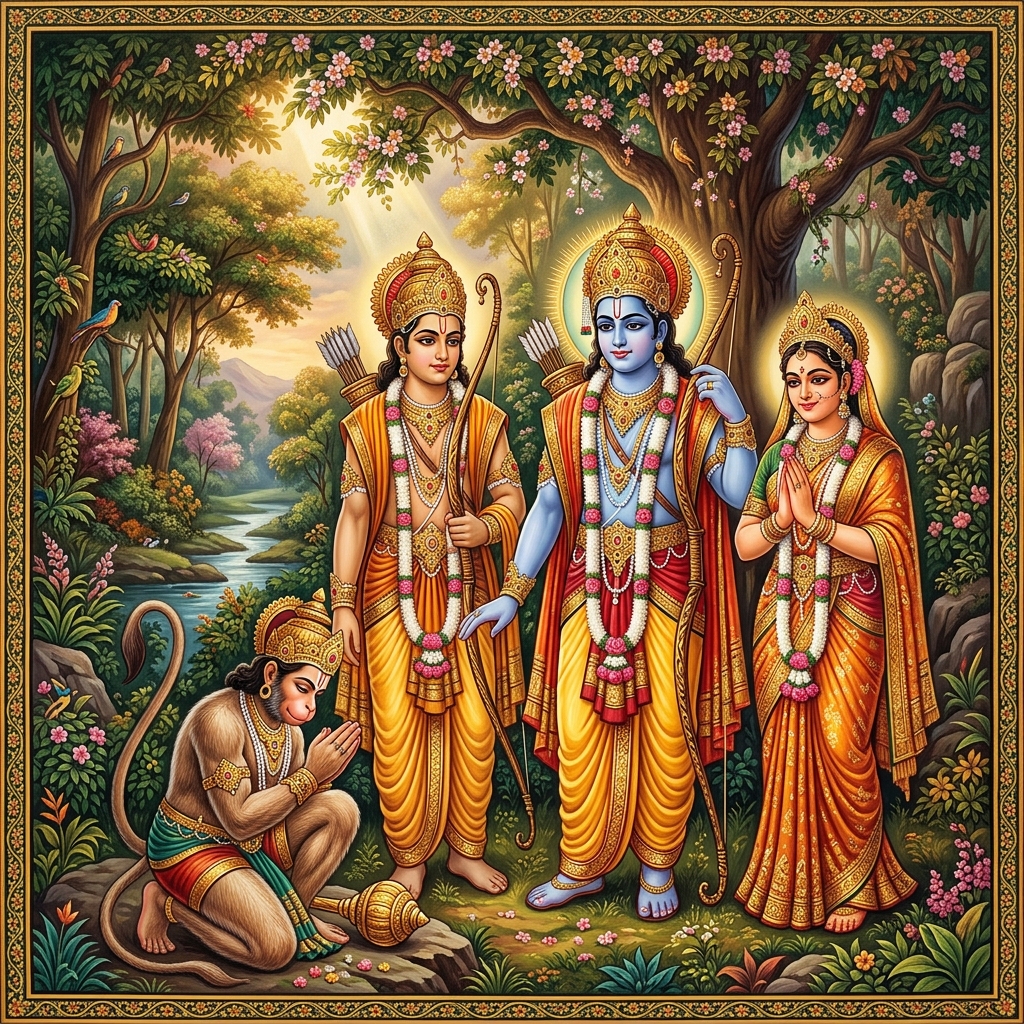
The Ramayana, composed by sage Valmiki, is one of the two great Sanskrit epics with 24,000 verses in seven Kandas. It narrates the life of Prince Rama — his exile, the abduction of Sita by Ravana, and the triumphant rescue through devotion and righteous war. It is the foundational text of dharmic living for over a billion people across Asia and the world.

  1. 📜 24,000 verses in 7 books (Kandas) — composed by sage Valmiki around 500 BCE, with oral roots far older
  2. 🏹 Rama — Maryada Purushottam: The ideal human who upholds righteousness even at immense personal cost
  3. 🌊 Sundara Kanda: Hanuman's legendary ocean leap to Lanka — the most beloved section of the entire epic
  4. 🌍 Pan-Asian epic: Adapted in Thailand, Indonesia, Cambodia, Bali, Malaysia and 11 other countries
  5. 🏛️ Angkor Wat: The world's largest temple features 800 metres of Ramayana bas-relief carvings
  6. 📺 100 million viewers watched the 1987 Ramanand Sagar serial — a world record at the time
  7. 🌿 Ecological wisdom: Forests are sacred; animals are divine collaborators in restoring cosmic order
  8. 👑 Ramarajya: Rama's ideal kingdom of perfect justice — Gandhi's central vision for independent India
data-en="Explore Full Story →" data-hi="पूरी कथा पढ़ें →">Explore Full Story →
Lord Rama, Sita, Lakshmana and Hanuman
🌀 Mahabharata

The Mahabharata — Ocean of Stories

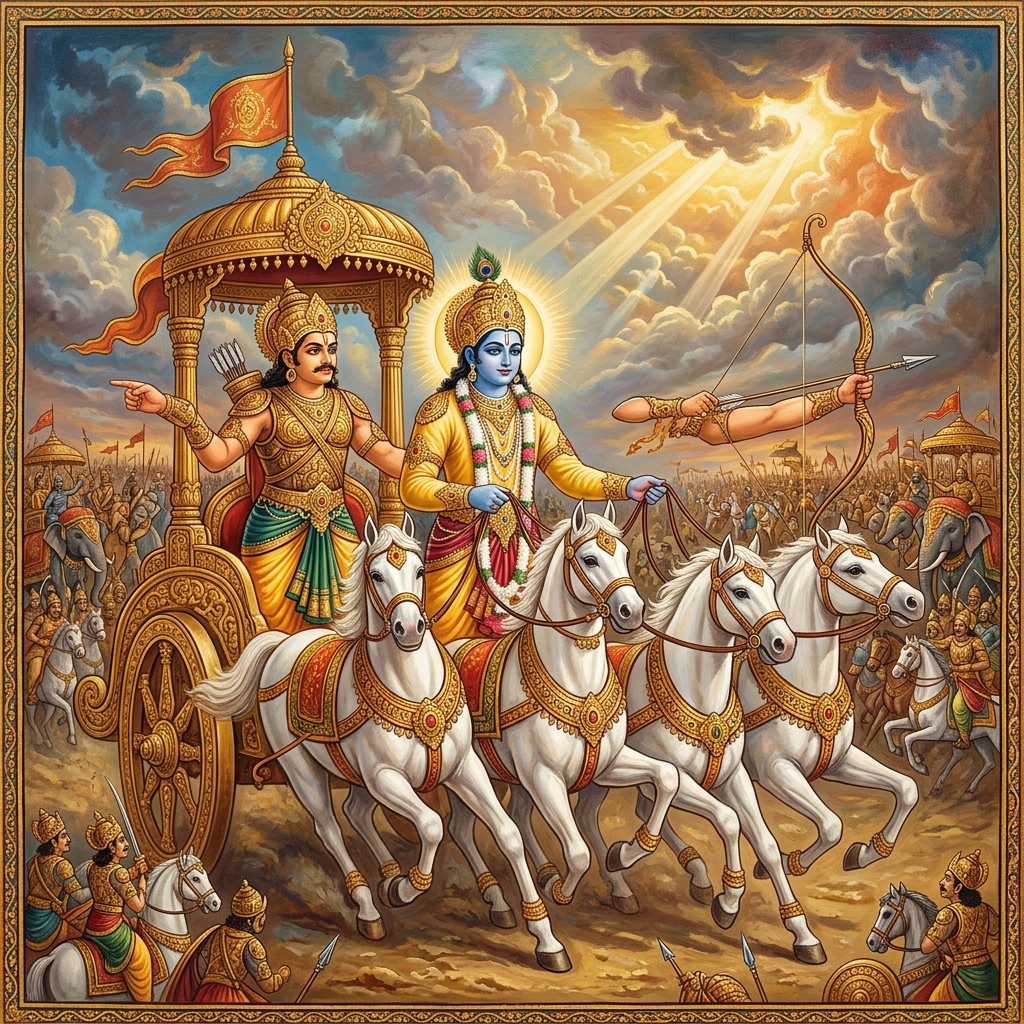
The Mahabharata, composed by sage Vyasa, is the longest epic poem ever written — 100,000 verses in 18 Parvas, ten times the Iliad and Odyssey combined. It narrates the great Kurukshetra War between the Pandavas and Kauravas but is fundamentally humanity's deepest exploration of dharma, moral complexity, justice, and the nature of reality.

  1. 📖 100,000 verses in 18 Parvas — the world's longest epic poem by the sage Vyasa
  2. 🎵 Bhagavad Gita: 700-verse dialogue of Krishna and Arjuna — among humanity's greatest philosophical texts
  3. 🎲 Sabha Parva: The dice game that humiliates Draupadi — the moral pivot that ignites the war
  4. ⚔️ 18 days at Kurukshetra involving millions of warriors, divine weapons, and cosmic forces
  5. 🦅 Karna: Literature's most tragic figure — denied his birthright, loyal to the wrong side out of gratitude
  6. 🧘 Shanti Parva: Bhishma's teachings on governance and liberation delivered from his bed of arrows
  7. 🏛️ Dwaraka: Krishna's submerged city discovered by archaeologists off the Gujarat coast in 2001
  8. 🌍 Global influence: Peter Brook's 9-hour adaptation toured 30 countries; Gita studied in 100+ nations
data-en="Explore Full Story →" data-hi="पूरी कथा पढ़ें →">Explore Full Story →
Lord Krishna and Arjuna at Kurukshetra
← Back to Home